
When they reach Sixth Form, students choose between the French track leading to the French International Baccalaureate (BFI) and the International Baccalaureate Diploma (IB). Both diplomas are recognised and valued by the world’s most prestigious universities. Our lycée (Year 11 – Year 13) is also an American Section Internationale.
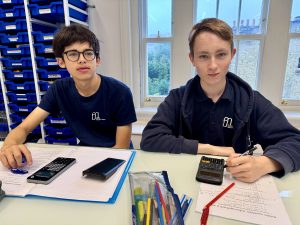
The Baccalauréat Français International (BFI)
The French International Baccalaureate (BFI) is an academically-enhanced version of the French baccalaureate. It is a bilingual and bicultural exam taken by less than 1% of French baccalaureate candidates worldwide.
The curriculum of the BFI follows that of the French baccalaureate except for specific modules that are taught in English and require demanding written and oral examinations in English.
The BFI is not simply an option added to the standard Baccalaureate; the English-language modules replace their equivalent in the French Baccalaureate and weigh significantly in students’ overall exam results. For more information on exam and curriculum content, please consult the Ministry of Education’s official website here.
As an American International Section, the BFI curriculum and exam content is determined by French and US official education organisms. Students are graded based on the marks they obtain in their exams, which are graded out of 20. Exams follow a weighted system: some subjects weigh more than others in students’ overall grades. To pass the BFI, students must obtain a minimum global average of 10/20.
More information on the American International Section of the BFI can be found on this link.
BFI Subjects at Jeannine Manuel School
In addition to core subjects, students are able to take the following subjects as Speciality Subjects:
- Histoire géographie, géopolitique et sciences politiques (HGGSP)
- Humanités, littérature et philosophie (HLP)
- Mathématiques
- Physique-chimie (PC)
- Sciences de la vie et de la terre (SVT)
- Sciences économiques et sociales (SES)
BFI Results
BFI (2022-2025): students achieved 100% success rate, 100% with mention Bien or Très Bien, including 69% of Très Bien. Of these, 37% obtained the prestigious Félicitations du Jury. In 2025, the BFI average score was 17.2/20, with 86% students obtaining mention Très Bien, of which 42% obtained the Félicitations du Jury.
In their Advanced Placement (APs) (new since 2025 in the BFI), students obtained a total average score of 4.5/5 (vs a world average of 2.9). They averaged 4.4 in English Lit & Comp, 4.8 in European History, 4.4 in Human Geography and 5 in Calculus BC and AB Subscore.
After Jeannine Manuel School
Preparing for the future
In the years after they leave us, many of our students will be applying for jobs that do not yet exist and solving problems that have yet to arise. Our ambitious bilingual curriculum equips them with the skills they need to succeed and thrive anywhere in the world.
The global higher education market available to students who are truly bilingual is vast, complex and ever-changing. They can pursue higher education across the world and most will choose to combine the best of several higher education systems: for our pupils, the possibilities can easily seem as endless as they are exciting.
Our team of experienced college counsellors and university advisors help our students and their families decipher the options available to them and support them throughout the application process. In addition to the individual counselling sessions each student receives, they also have access to our varied programme of conferences, speaker events, workshops, psychometric testing, and admissions test and interview preparation. Our counselling programme is tailored to help each student define their aspirations and recognise their strengths, thereby making them the lead actor of their own future.
While formal counselling begins in Year 10, students start preparing for life after school long before that. Whether they are in the classroom, on the sports pitch or out volunteering, our students are developing skills in critical thinking, collaborative work, creative problem-solving, altruism and resilience – all of which they will need to flourish in the future.
University Destinations & School Profile
Find out more about our students’ university destinations in our school profile below, and click here to view the full list of university offers.