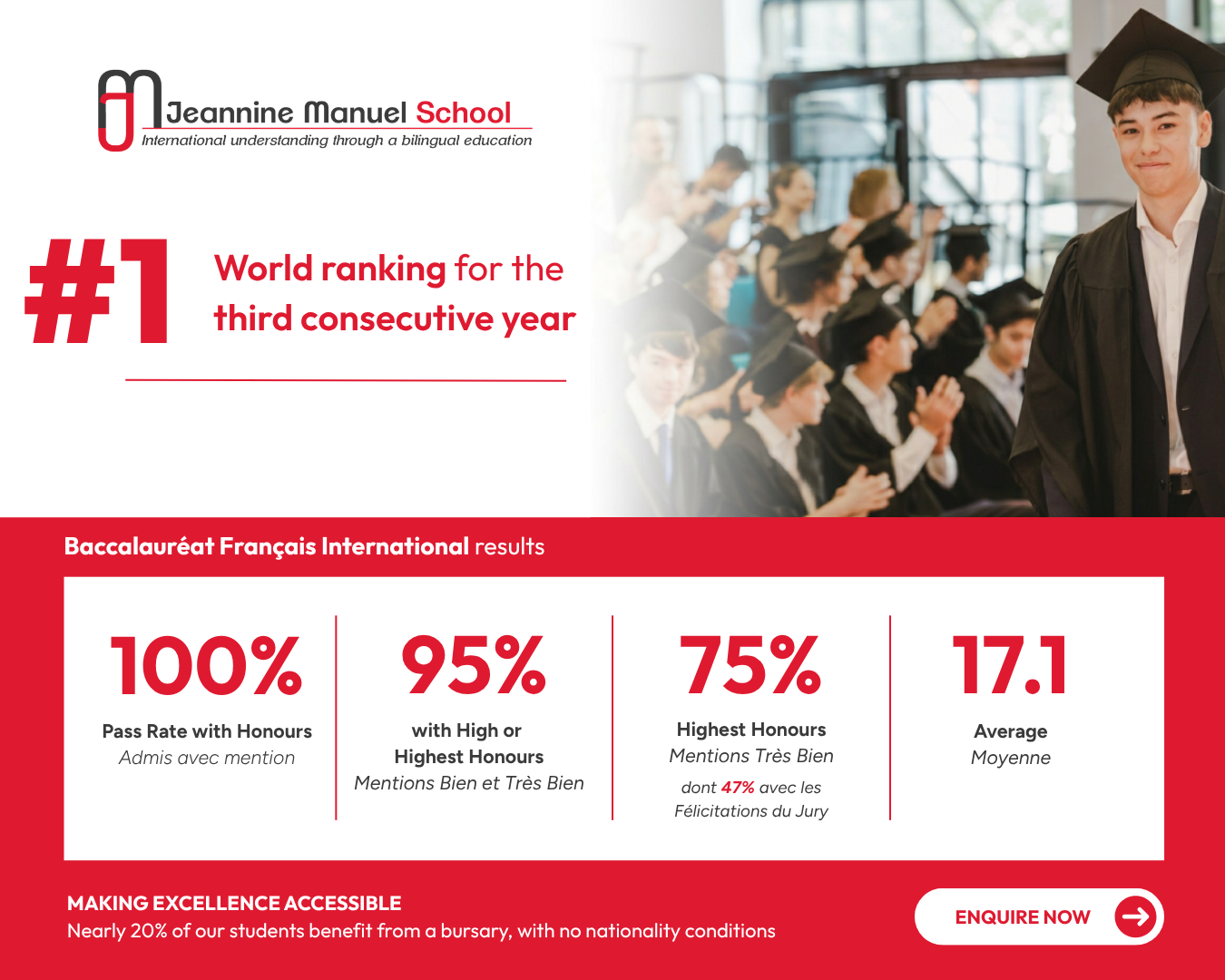
When they reach Sixth Form, students choose between the French track leading to the French International Baccalaureate (BFI) and the International Baccalaureate Diploma (IB).
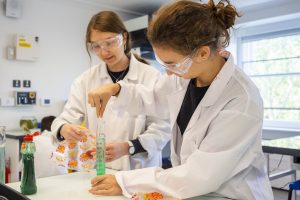
The International Baccalaureate
The IB Diploma Programme offers a liberal arts international curriculum respected by leading universities across the globe. See http://www.ibo.org/programmes/diploma-programme/.
The curriculum is made up of a program core and subjects distributed among six subject groups, which include an array of courses to choose from. The groups are as follows:
- Group 1: Studies in language and literature
- Group 2: Language acquisition
- Group 3: Individuals & societies
- Group 4: Sciences
- Group 5: Mathematics
- Group 6 : The Arts
Students choose one subject from each of the groups described above. Students may opt to study an additional sciences, individuals and societies, or languages course, instead of a course in the arts.
Jeannine Manuel School also offers the Bilingual IB Diploma (more information here).
At least three, and not more than four subjects selected are taken at higher level (HL) and the others at standard level (SL).
The Diploma Program core aims to broaden students’ educational experience and challenge them to apply their knowledge and skills; it includes:
- Theory of knowledge, in which students reflect on the nature of knowledge and on how we know what we claim to know.
- The extended essay, which is an independent, self-directed piece of research, finishing with a 4,000-word paper.
- Creativity, activity, service (CAS), in which students complete a project related to one of those three concepts.
Our IB Results
Statistics for 2021-2025 :
| Grades | IB World |
Jeannine Manuel School
|
| 40-45 | 9% | 44% |
| 35-45 | 30% | 81% |
| 30-45 | 58% | 93% |
In 2025, our IB average was 38 (vs 30.5 world average)
IB Subjects at Jeannine Manuel School
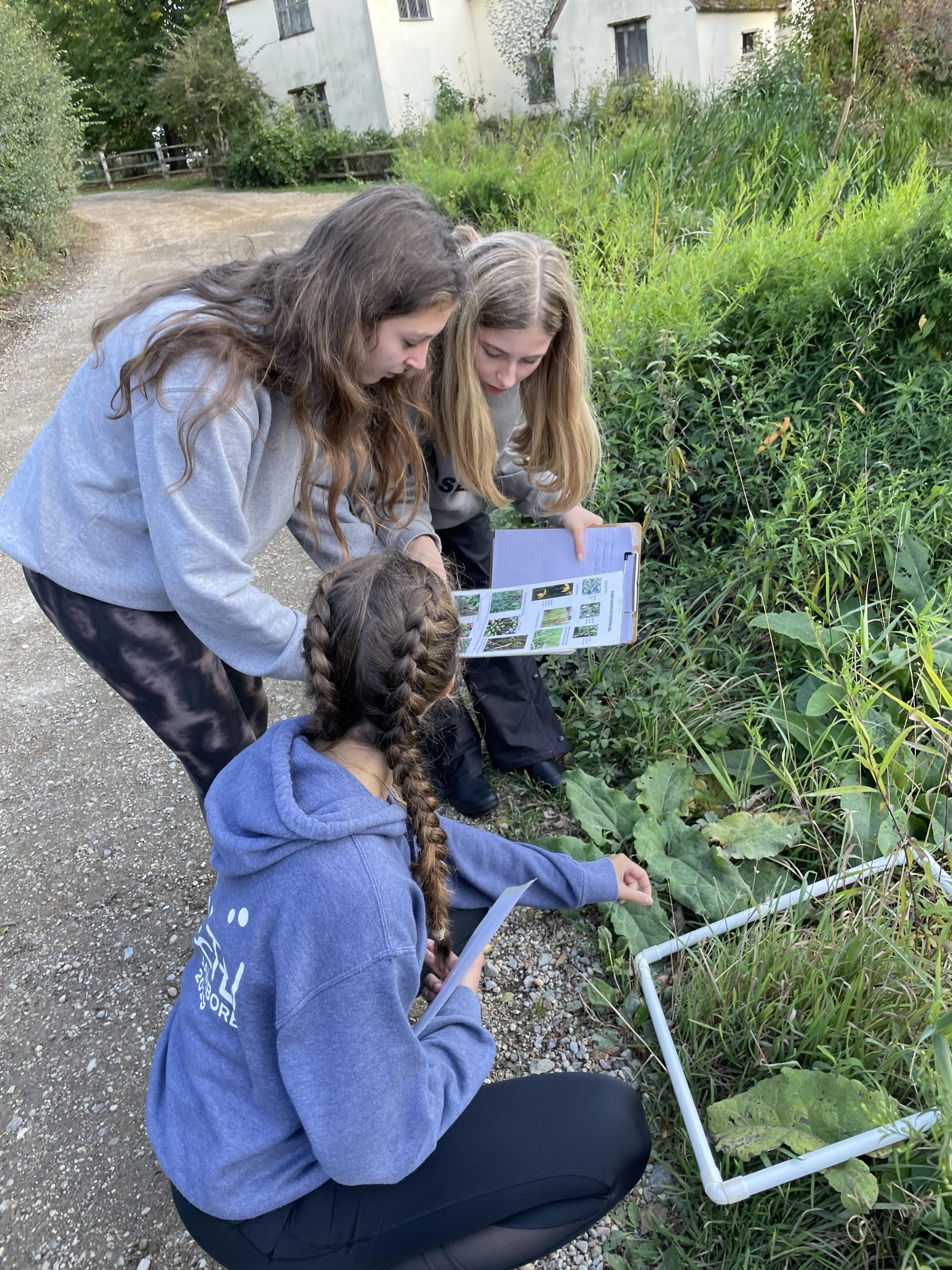
The subjects below will be available for September 2026. Please contact us to find out more about subject combinations, including for the Bilingual IB.
-
Studies in Language and Literature
- Language A – Literature : English
- Language A – Language and Literature : English
- Language A – Language and Literature : Français
-
Language Acquisition
- Language B (SL only) : Français SL
- Language B (SL only) : Spanish SL
-
Individuals and Societies
- Business management
- Economics
- Environmental Systems and Societies (SL only)
- Geography
- History
-
Sciences
- Biology
- Chemistry
- Environmental Systems and Societies (SL only)
- Physics
-
Mathematics
- Mathematics Analysis and Approaches (HL only)
- Mathematics Applications & Interpretations (SL only)
-
The Arts
- Visual arts
After Jeannine Manuel School
Preparing for the future
In the years after they leave us, many of our students will be applying for jobs that do not yet exist and solving problems that have yet to arise. Our ambitious bilingual curriculum equips them with the skills they need to succeed and thrive anywhere in the world.
The global higher education market available to students who are truly bilingual is vast, complex and ever-changing. They can pursue higher education across the world and most will choose to combine the best of several higher education systems: for our pupils, the possibilities can easily seem as endless as they are exciting.
Our team of experienced college counsellors and university advisors help our students and their families decipher the options available to them and support them throughout the application process. In addition to the individual counselling sessions each student receives, they also have access to our varied programme of conferences, speaker events, workshops, psychometric testing, and admissions test and interview preparation. Our counselling programme is tailored to help each student define their aspirations and recognise their strengths, thereby making them the lead actor of their own future.
While formal counselling begins in Year 10, students start preparing for life after school long before that. Whether they are in the classroom, on the sports pitch or out volunteering, our students are developing skills in critical thinking, collaborative work, creative problem-solving, altruism and resilience – all of which they will need to flourish in the future.
University Destinations & School Profile
Find out more about our students’ university destinations in our school profile below, and click here to view the full list of university offers.